
Understand the available data.
Review asset and operating information, identify missing inputs, and document assumptions associated with imputed variables.
A structured assessment of corrosion predictions, pitting susceptibility, remaining life, and damage mechanisms to support engineering review and investigation priorities.
Genesis evaluated 25 upstream pipeline assets using AI-ACRIM Plus, bringing together monitoring-based and in-line inspection (ILI)-based analytical outputs in a technical report.
The assessment examined asset-level differences, potential damage mechanisms, and data gaps to help focus further technical review.
This anonymized platform capture shows the corrosion-modeling view, with monitoring and ILI outputs presented alongside the AI-ACRIM Assistant.
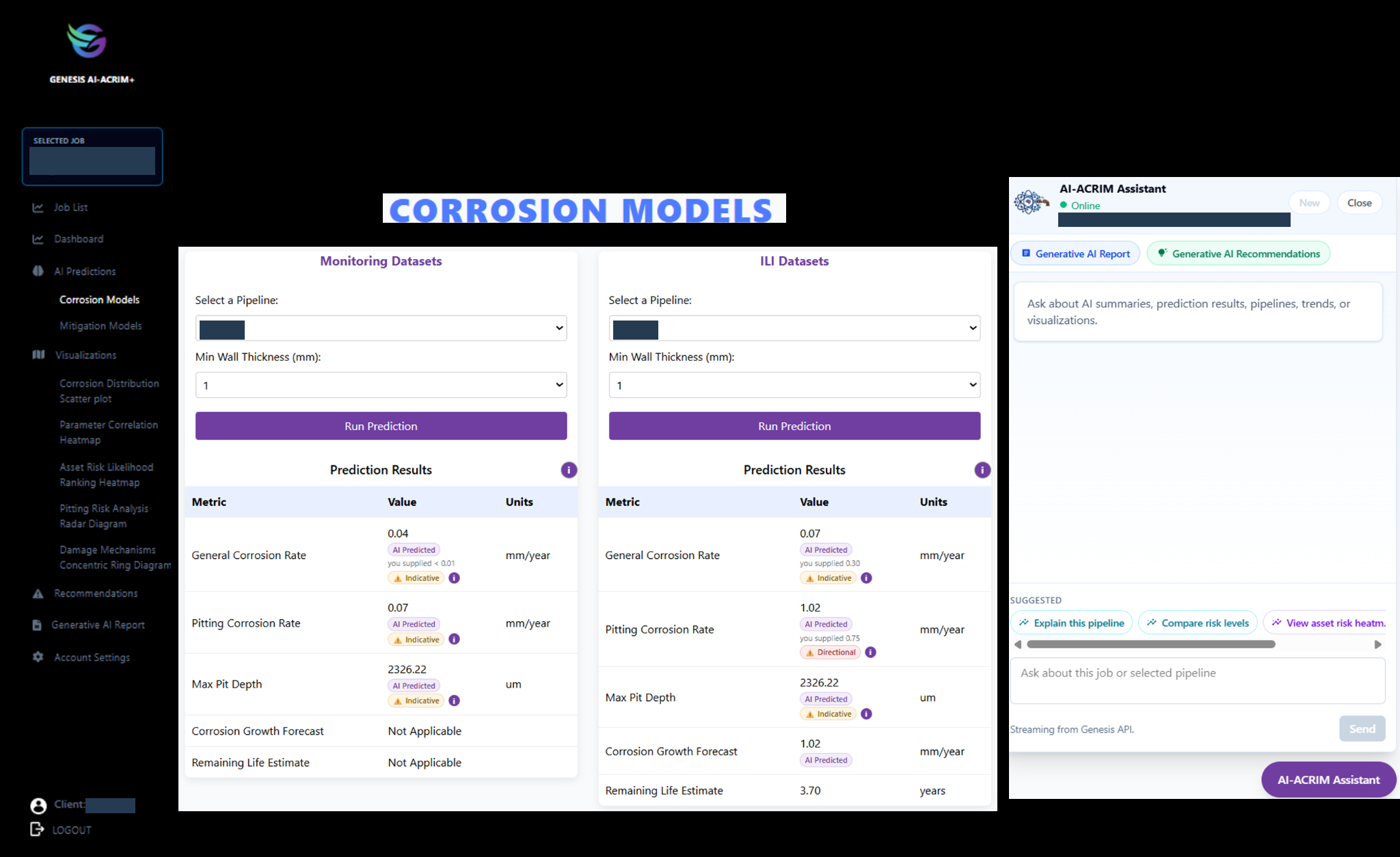
Displayed values are model outputs from this assessment. The interface retains its indicative and directional labels for engineering interpretation.
Review asset and operating information, identify missing inputs, and document assumptions associated with imputed variables.
Examine monitoring- and ILI-based model outputs for general corrosion, pitting, remaining life, susceptibility, and damage mechanisms.
Review predicted patterns, identify assets requiring closer examination, and define field-data and validation priorities.
These findings describe analytical outputs and investigation priorities from the project.
Monitoring-based outputs identified assets with higher predicted general or pitting corrosion. ILI-based outputs produced a different pattern, reinforcing the need to interpret each assessment in context.
The model-indicated damage profile was dominated by under-deposit corrosion, with erosion-corrosion secondary. These indications provided a basis for targeted technical investigation.
The report identified missing or weak inputs related to operating conditions, fluid chemistry, microbiological information, service history, and inspection records.
The assessment defined priorities for additional field and inspection data, review of higher predicted corrosion outputs, and examination of imputed-input assumptions.
The project also produced an AI-assisted mitigation summary to help organize inspection, treatment, and maintenance discussions. Recommendations remained directional and contingent on subject-matter expert review and additional field data.
Organized assets for inspection review and outlined potential inspection approaches according to the assessed risk group.
Highlighted corrosion-inhibitor treatment priorities and identified where missing microbiological or scale information prevented quantitative treatment guidance.
Generated indicative pigging guidance for review against operating constraints, asset conditions, and complete input data.
Prioritized operating and chemistry inputs, microbiological information, and field treatment records to support reassessment and model development.
Limited supplied inputs required the use of training-median imputation for missing variables. This constrains confidence in asset-specific predictions.
The report calls for field and ILI validation of pitting outputs, review of classifications, and client and Genesis subject-matter expert assessment before quantitative engineering decisions.
The project delivered a consolidated technical assessment across 25 assets, bringing predicted patterns, priority findings, data limitations, and follow-up requirements into one engineering review.
Connect with Genesis about data and AI, corrosion and integrity, or a research and innovation opportunity.
30 minutes · Online via Microsoft Teams